


 Česky (CZK)
 Slovensky (EUR)
Choosing latex clothing

How to Choose Latex Clothing Correctly?
Can you be advised remotely on which latex clothing suits you and which doesn't? In over 15 years, we've answered so many questions that it could fill a latex textbook. We know what you often ask, what interests you, and where you make the most mistakes when choosing.
The most common issue is the number of items that look very similar in pictures. A demanding customer usually picks up the phone or writes an email, where they precisely describe their requirements, what they expect from each product, and what they don't want. Ideal - that's how it should always be! Together, we can avoid unnecessary exchanges, and you'll get exactly what you desire the first time. However, it often doesn't work so well, and the customer chooses based on criteria that are not entirely ideal.
Incorrect Criteria When Choosing Latex Clothing
1. Price
It's logical. If I see 3 identical things, I naturally choose the cheapest one. But beware! What looks the same in pictures can actually differ in essential parameters. The rule that price corresponds to quality applies here as it does anywhere else.
2. Quality of Photos
A good package or photo sells the product. This has been true since time immemorial. However, don't be fooled. Just because a company can hire a good photographer, graphic designer, makeup artist, etc., doesn't mean they can manufacture their goods just as well, and vice versa, a company that puts maximum effort into production sometimes doesn't care as much about how they present their goods. For example, German Blackstyle, which produces latex clothing of the highest quality, but most of their photos look rather ordinary.

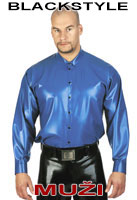

3. Models
Believe it or not, just as the quality of a photo can mislead a customer, so can the attention be diverted by which model (or model) the collection is photographed on. We remember a customer who was choosing a latex dress. He quite liked one, so we offered him another variant. The same, from the same manufacturer, just with longer sleeves. But they were photographed on a different model, and the customer was convinced that one version was great and the other terrible.
Remember - you're not buying the model, but what they're wearing!
Basic Differences in Latex Clothing Processing
Or what a customer should be interested in before buying the garment…
Not All Latex is the Same
Latex is obtained from rubber tree milk. Before it reaches your wardrobe, it must go through certain manufacturing procedures, and it is logical that it comes out with slightly different properties from each factory. You can tell the material from different manufacturers by touch and sometimes by sight. Some "connoisseurs" therefore shop exclusively with their favorite brand. This is usually preceded by years of trying and testing.
Clothing Can Be Dipped or Glued
- Dipped is cast on a mold from which an almost finished garment is peeled off. Only the edges need to be trimmed, and zippers glued on, if necessary.
- With glued, the production is similar to sewing from classic fabric. Pieces are cut from latex fabric and glued together.
Fans of dipped latex highlight primarily that the garment is made from a single piece, without seams and glued joints, and thus better resembles the famous "second skin." However, this is the only "pro" and not entirely justified. If a glued garment is made well, the seams are hardly visible after polishing, and the person wearing the latex has no chance of feeling them.
Disadvantages of Dipped Latex:
- Generally more prone to tearing.
- It is never possible to achieve a constant thickness because before the latex vulcanizes, it naturally runs down the mold. It is in these weaker spots that defects can easily occur.
- Cannot be made to measure. It would involve designing a completely new casting mold.
Glued Latex, on the other hand, has advantages in these areas:
- The fabric itself is simply of higher quality than dipped latex.
- The fabric has a constant thickness, so there is no stretching of weakened areas prone to defects.
- Glued clothing can be made to measure, color combined, and otherwise customized for the customer.
- With a little skill, you can make your own outfits and accessories from the fabric.
Of course, there is also very high-quality dipped latex. Moreover, some things cannot be made any other way than by casting. These are mainly gloves or penis sleeves. The vast majority of stockings and socks are also made this way.
Latex Thicknesses
Whether latex is cast or glued, an important factor is the strength and elasticity of the material. It is precisely this that most influences comfort and usability for each model and, last but not least, durability. For latex clothing and accessories, material ranging from approximately 0.18 - 2 mm is used, mostly 0.35 - 0.60 mm. As we mentioned, with dipped latex, it is not possible to maintain a constant thickness in all parts of the garment, whereas with fabric, it is. Thinner material is suitable, for example, for masks or underwear, thick for corsets, cuffs, or immobilizing bags.
For detailed information, read the article Latex Thicknesses.
Every Company Does It Their Own Way
Just as every manufacturer uses their specific material, they also have their original cuts, methods of gluing, and, the stumbling block, sizes.
When shopping online, you usually have no choice but to rely on your intuition, and even the most detailed description cannot replace the ability to touch and try the goods. Latex has a big plus compared to other materials in its elasticity, so the same piece of clothing often fits different bodies well, which doesn't exist with other materials. Still, it's important to pay great attention to size selection!
Latex clothing should be smaller than body proportions to achieve a slight tension and prevent unaesthetic bunching. For example, if you have a circumference of 100 cm at the widest point over the buttocks, the skirt should be 85 - 95 cm in this area, depending on the latex thickness used. From one manufacturer, size M will fit you, from another L, and from another even XL.
For your maximum orientation, we've created size charts for each manufacturer separately. Take a look, and you'll agree it's quite a mess :-) Size Charts >>
We dare to say it's the most comprehensive size overview in the world, but even so, don't take the charts as a dogma! To be 100% sure you don't make a mistake when choosing, follow the only advice, which is:
Contact the Seller!
Whether you're shopping with us or elsewhere, first discuss your measurements and exact ideas with the seller. In some stores, they'll refer you to a so-called "reliable" size chart, elsewhere they'll try to give some advice, and elsewhere they'll be completely off the mark.
With us, you have the certainty that we will give you 100% attention. We have over 15 years of experience and a number of regular customers. Their trust didn't come by itself. We've always done something extra for them. Before confirming the order, we wrote emails as long as this article, personally measured the clothing for them, and photographed details. Don't shop thoughtlessly. Spend a moment on a short consultation before ordering and CONTACT US! It will pay off just like for many before you ;-)
Don't miss other articles and always have them firsthand.
Subscribe to our newsletter, and you won't miss anything >>>
Author: Martin Hrubý - MH Sexshop

Founder and operator of MH Sexshop and author of all the texts on these pages. Since 2004, I've been handling all orders and advising you on purchases. More info can be found in the About Us section.